
.png)
(Dedi Yahya from D3 Ship Electrical Engineering Study Program)
The ship is a marine building that has a fairly complex system where there are many systems that are used in it and are interconnected. Therefore, security and safety must be the main consideration in the operation of the device on the ship. The electrical system on the ship has a complex system, for example the electrical system found in the ECR (Engine Control Room). However, the fire alarm system used in the room is still not integrated with the carbon dioxide extinguishing system. Fire alarms cannot immediately activate the carbon dioxide extinguishing system. After the alarm sounds the carbon dioxide extinguisher must first be activated manually by the crew by turning the valve in the carbon dioxide storage room. This final project will create an automatic fire extinguishing system that is integrated with an early warning system, fire alarm, human safety system and fire extinguishing system. This tool works with an early warning system to identify gas leaks and a fire alarm system as a fire extinguisher trigger system. The initial system will trigger the activation of the PIR sensor to detect the presence of humans. When the PIR Sensor does not detect humans, the ventilation system will be closed and the carbon dioxide extinguishing system will be active. Carbon dioxide gas will continue to be released into the room until the fire sensor no longer detects a fire source in the room. The ventilation system will reactivate when the carbon dioxide extinguishing system has finished extinguishing the fire. During a blackout, the buzzer will continue to be active until the system CO2 levels are below 600 ppm.
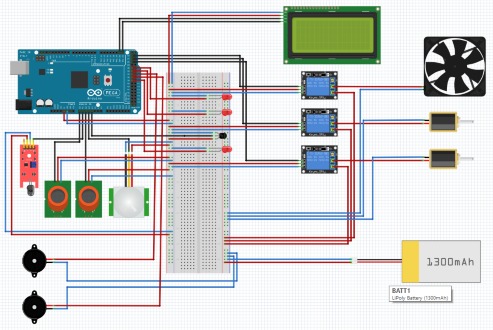
This system consists of gas leak detection, fire emergence to fire suppression measures. The system runs with initial detection by the MQ-2 sensor as a gas detector. The system is also connected to a buzzer to give a short sound to alert the presence of flammable gas in the air.
The leak detection system will also be equipped with a temperature sensor to provide a warning that there will be a potential fire due to an increase in temperature above the average air temperature. When an increase in temperature is detected from the average air temperature, the system will sound a buzzer for the second time briefly as a second warning.
Then the fire sensor detects the occurrence of fires in the room. When a fire is detected, the sensor will trigger the PIR (Passive Infrared Receiver) sensor to activate and a fire notification will appear on the LCD and sound a buzzer for the third time until the extinguishing process is complete. An active PIR sensor will detect humans in the room. After the PIR sensor no longer detects the presence of humans in the room, the system will close the ventilation system and open the valve connected to the carbon dioxide tube. The valve will continue to open until the fire sensor no longer detects a fire source. After the carbon dioxide solenoid valve is closed, the system activates the fan and opens the air vent line to exhaust the carbon dioxide gas. During the blackout process, the buzzer will continue to be active until the CO2 sensor detects CO2 levels below 600 ppm.
Series of Prototype Automatic Fire Extinguishing System Using Carbon Dioxide as Extinguishing Material
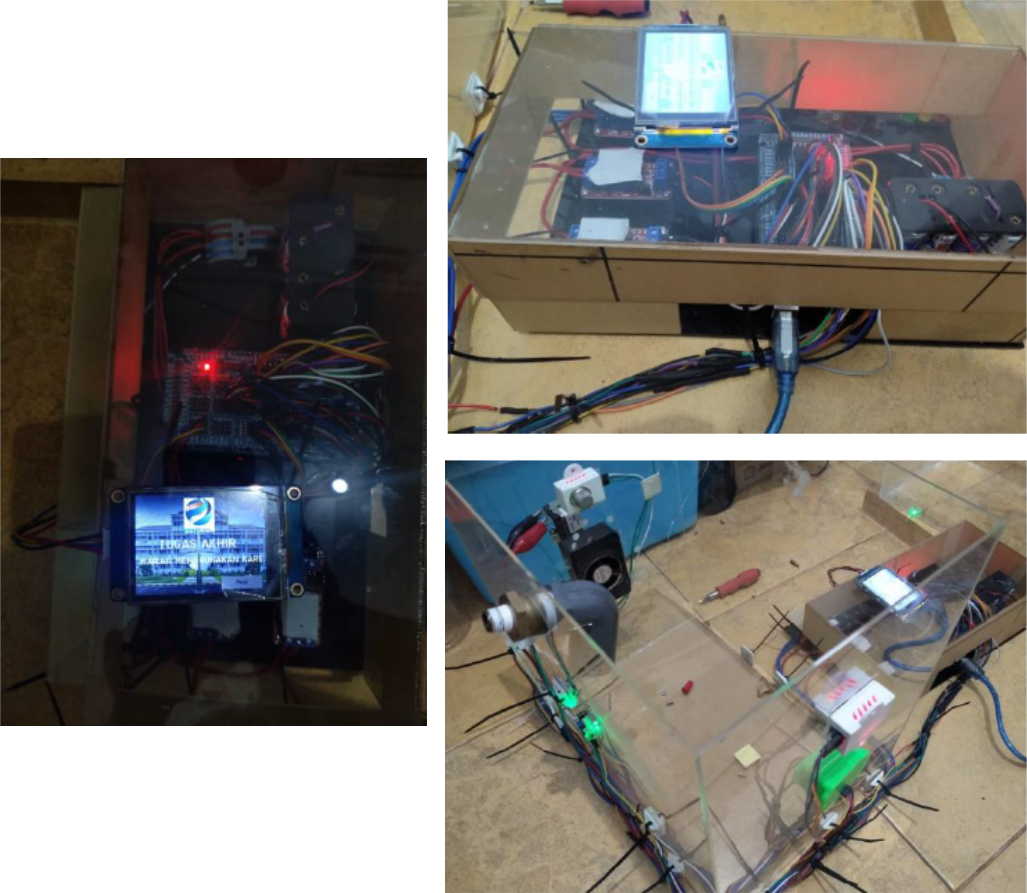
Experimental results of the Prototype of Automatic Fire Extinguishing System Using Carbon Dioxide as Extinguishing Material
.jpeg)
.jpeg)